· 6 min read
From Strength to a High-Performance Team
At the start of 2019, all of us on the management team received the same book from our then HR manager: “Develop Your Strengths” – complete with an access code to the StrengthFinder 2.0 (external link, opens in a new tab) (officially CliftonStrengths (from Gallup). What initially looked like a nice team-building gimmick went on to become one of the most influential tools in my leadership work.
However, the trigger had already occurred back in 2014: Charleston
I actually got the book five years earlier from Ilse de la Cruz (external link, opens in a new tab), whilst I was in Charleston. She is now a Gallup-certified Strengths Coach and, back then, she gave me something that has had a lasting impact: If we define people not by their role, but by what they are really good at, the way a team works together changes – fundamentally.
177 questions, 20 seconds, no thinking
The test itself is unspectacular, and that is precisely why it is effective: For around 30 minutes, you are presented with 177 pairs of statements – such as ‘I love making new friends’ versus ‘I love spending time with old friends’ – and have to decide which of the two is more true for you. You only have 20 seconds per question; after that, the test moves on automatically (I’ve got a ‘fun fact’ about this as well, but I’ll only tell you that in private 😉).
It is precisely this time limit that is the trick. You don’t have time to concoct a ‘better’ or socially desirable self-image – you answer on instinct. In the end, you don’t get an opinion of yourself, but rather a pattern: a ranking of all 34 strengths, from the strongest to the weakest. Your Top 5 strengths will be given to you straight away.
My own strengths – and what I do with them
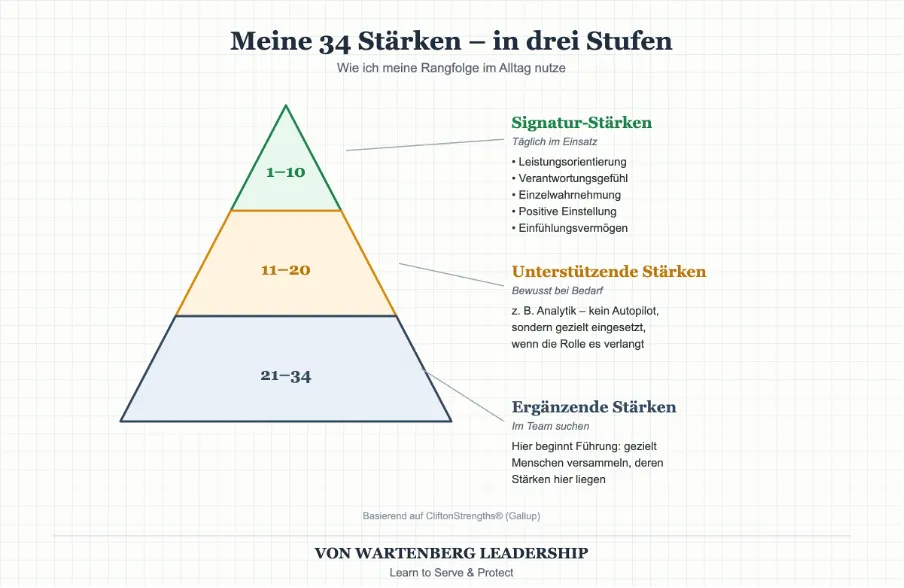
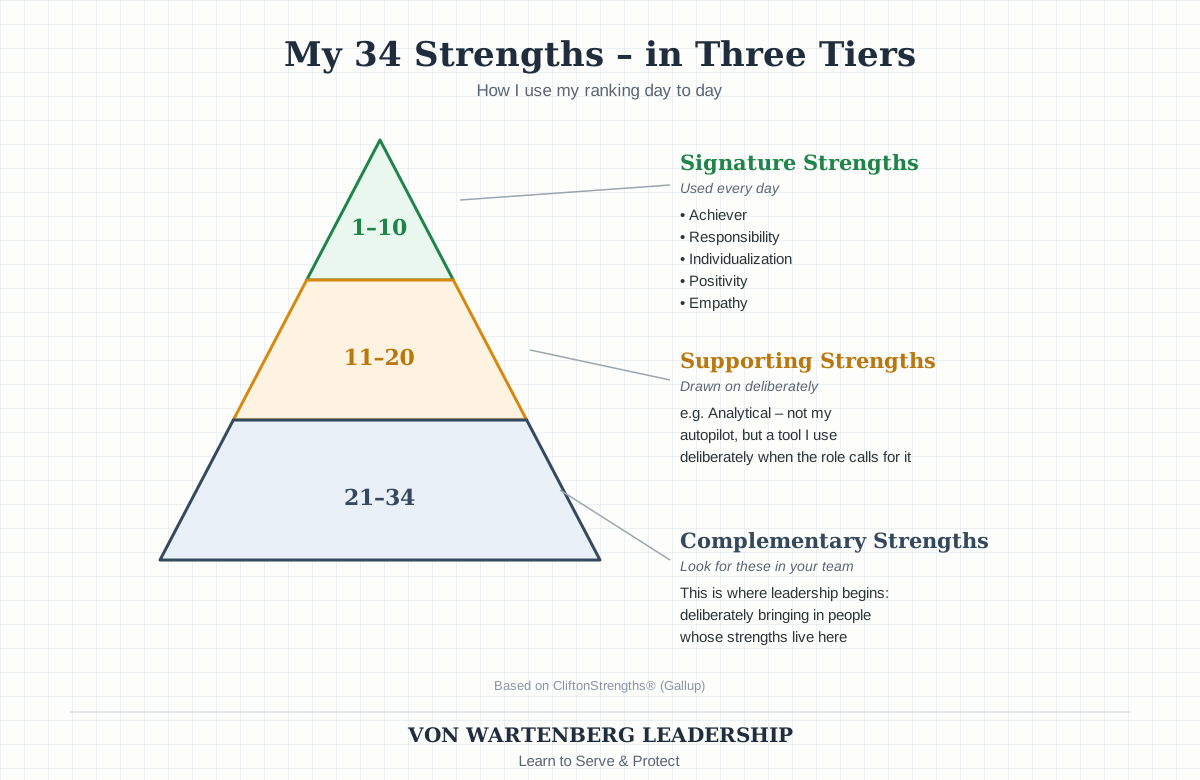
I currently have Performance-based approach, sense of responsibility, Individual perception, A positive attitude and Empathy right at the top. To be honest, this combination doesn’t surprise me at all: it describes quite accurately how I lead – setting high standards for myself, but always keeping the individual person in front of me in mind. However, it only becomes really interesting when you look at the full list of 34 and think in terms of three levels:
Strength 1–10 – the everyday tools. These are the strengths that I use almost automatically, without consciously thinking about them. They shape the way I make decisions, the way I interact with people, and the way I gauge a room.
Strength 11–20 – the tools I reach for when needed. A good example from my own experience: analytical thinking. Over the years, I’ve often been told that I’m “very analytical” – yet, in reality, analytical thinking isn’t even in my top 10. It’s a strength I possess and can deploy very deliberately when the role demands it – and as a CFO, it does demand it quite often. But it’s not my natural ‘autopilot’; rather, it’s a tool that I specifically take off the shelf when needed.
Strength 21–34 – that’s when I look to my team. These are the areas where I myself am least naturally gifted. And this is precisely where leadership, in the true sense of the word, begins: not trying to fill these gaps myself, but making a conscious effort to ensure they are covered within the team. If I know where my own weaknesses lie, I can deliberately surround myself with people whose strengths lie precisely where mine end.
It is precisely at this point that a useful self-awareness tool becomes a genuine leadership tool.
From the ‘Potential Team’ to the ‘Real Team’
True value does not come from knowing one’s own strengths, but from what happens afterwards: the team discussion.
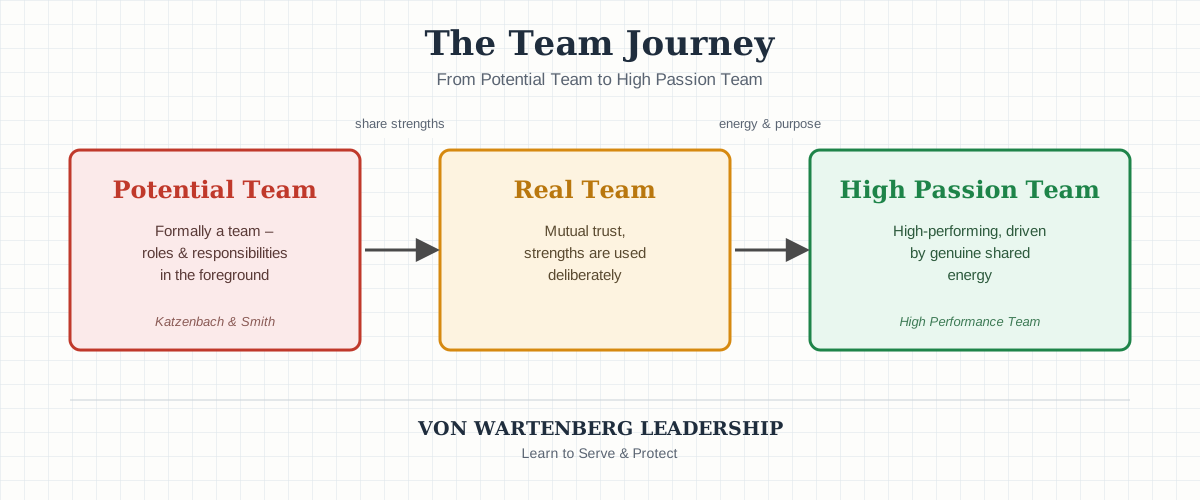
We began to openly share our strengths with one another – who brings what to the table, where do we complement one another, and where do our skills overlap? From a group that was formally a team but didn’t yet really function as one – Katzenbach and Smith would call it a ‘potential team’ – we gradually became a genuine team. And along the way, we developed something together that, looking back, I would describe as ‘High Passion Team" would describe it: not just powerful, but driven by a genuine shared energy.
That was no coincidence. It was the result of deliberately and repeatedly talking about strengths, rather than just roles and responsibilities.
When it takes on a life of its own
What pleased me most was that the idea caught on. Other teams – within the corporate group – have started doing the same. Some have organised their own workshops, in which everyone presented their own strengths. Others have started directly with the Gallup app (external link, opens in a new tab) worked.
And then came the next logical step: a colleague from my team took the individual analysis and turned it into a Tool created – a template that can be used to Showcasing the strengths of an entire team at a glance. Each person gets their own "Top 5 Strengths Footprint", and if you stack several on top of one another, the result is the Team Footprint: Where does the team excel, and where are its blind spots? This brings to light what was previously only a hunch – and provides very practical help, for example, when it comes to deciding who is really the right person for a particular task or to fill a vacancy.
Why this is more than just an HR tool
For me, StrengthFinder is ultimately not a tool, but a Posture: Leadership that does not seek to eliminate weaknesses through training, but consciously harnesses a team’s existing strengths. That’s not soft – quite the opposite. It’s one of the most direct ways of turning a team into a truly high-performing one.
That’s exactly what I touched on in my very first blog post, when I wrote about the Team model As Katzenbach and Smith have written: The path from a potential team to a high-performance team does not lie in exercising more control, but in gaining greater clarity about who we really are as a team.
Here’s the Amazon link LINK (external link, opens in a new tab) to the Book (including access code for the test): "Develop your strengths: StrengthsFinder 2.0 – With a personal access code to the CliftonStrengths© assessment"
What has been your experience of StrengthFinder or similar strengths-based tools within your team? Give it a go! I’d love to hear your thoughts, see LinkedIn (external link, opens in a new tab).
Dr Peter von Wartenberg (07.20)
VON WARTENBERG LEADERSHIP
Learn to Serve and Protect