· 5 min read
Why we hate change – and how you can still get people on board

Recently – once again thanks to a tip-off from a colleague – I stumbled across a TED Talk that has really stuck with me: "Change Doesn't Have to Be Scary" by Kristy Ellmer (external link, opens in a new tab), transformation expert and founder of the Behavioural Science Lab at BCG (external link, opens in a new tab).
I think I shared the talk on LinkedIn a while ago – but the The core message is timeless, and it goes so well with everything I consider to be Leading My Team I realise that I want to summarise them here once again for you.
The story that set everything in motion
Ellmer was 24 when her first employer – an airline with a long history – Insolvency had to log in. Mass redundancies were looming, and during this difficult period an external coach asked a question that has stayed with her to this day: What if, in the end, losing their job actually turns out to be a blessing in disguise for those affected?
At first, that sounded to her as though cynical. But the figures the coach presented convinced her: many of the made-redundant staff found – backed by their severance pay, their network and recommendations – the Courage, to break out of a rut. They set up businesses, undertook further training and moved into sectors they would never previously have considered.
This became her personal guiding question, one that I have since found myself asking more often whenever I am faced with an unwanted change: What if this is happening for me – not against me?
Why our brain sabotages change
The the most exciting part For me, the highlight of the talk is the biological. Ellmer explains that, from an evolutionary perspective, we are simply not built for change. As soon as we feel threatened, the amygdala releases cortisol and adrenaline – completely unconsciously and in a fraction of a second. Her analogy for this is: if you come face to face with a bear in the forest, shouts Your brain says, “Run!” – yet staying still would often be the wiser reaction. Exactly the same sequence of events unfolds, whether you’re actually standing face to face with a bear or your board of directors is announcing a merger.
To me, that explains why – as Ellmer reports – around 75 per cent of all business transformations fail. It is rarely down to the strategy. It is because people unconsciously work against change, as that is precisely how they are wired.
Tip 1: Know your own change story – and the five motivators
Ellmer’s first piece of advice: Before you make a change, write Your personal Change Story – Your ‘why’. And get your team to do the same.
The problem she identified in her research is that managers talk almost exclusively about financial performance indicators – Shareholder value, bonuses, share price. Yet their research shows five equally important motivators for a willingness to change: personal development, customers, team, community and financial results. Among 100 people, these are distributed almost evenly. So anyone who talks only about bonuses and key performance indicators is – according to their estimate – emotionally excluding around 60 per cent of the workforce.
I found her example from a mining company particularly moving: A manager, who had grown up in poverty herself, explained in a workshop how the upcoming transformation would lead to higher investment, more stable prices for customers, better wages and more funding for a poverty-alleviation programme – and, as an added bonus, could also free up more time for further training within the team. Five motivators, one story. Tears were flowing in the room. A numerical transformation turned into a shared mission.
Tip 2: Cognitive load rather than an activity heatmap
For me, the second lever is at least as relevant in practice: most organisations manage change using task heatmaps – and assume, in this context, that everyone has the same capacity. But someone with six tasks and plenty of energy might easily manage eight, whilst someone else is going through a divorce in their personal life and is already at their limit with just three tasks.
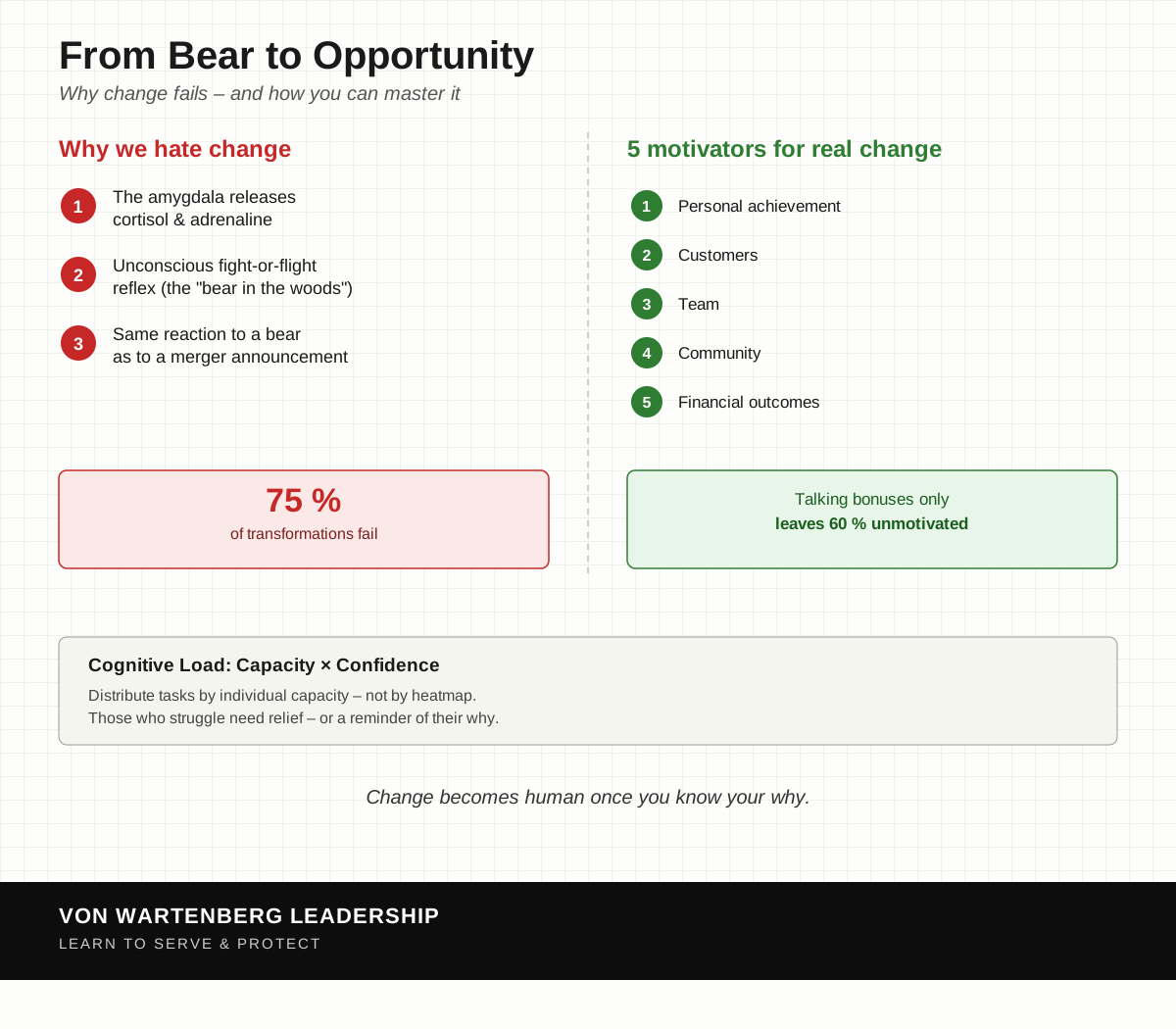
Ellmers Solution: the cognitive load measure – consisting of Capacity (time, energy, resources) and Confidence(Belief in one’s own ability to complete the task). A simple, five-minute survey is all it takes: a few questions about how you’re feeling at the moment, and a few specific questions about your capacity and confidence. Those who thrive are presented with new challenges. Those who struggle are given some breathing space – or a gentle reminder of their own ‘why’, combined with an encouraging message from a trusted manager.
Clicking “Load video” establishes a connection to YouTube (in privacy-friendly mode). Data may be transmitted to the provider - see our privacy policy.
What I take away from this for myself - both levers interlock:
- If you know your ‘why’, you have an anchor in stormy times!
- If you notice that someone is reaching their limits, you can step in in good time – before feeling overwhelmed turns into resistance.
- For me, that is the essence of Leading My Team: Change is not achieved through processes alone, but through a genuine interest in the people who are expected to implement them.
Where are you at right now – with your own story of change, or with your current cognitive load? And what if the change you’re currently struggling with is happening for you right now? I look forward to discussing this at LinkedIn (external link, opens in a new tab).
Dr. Peter von Wartenberg (06.25)
Source: Kristy Ellmer, "Change Doesn't Have to Be Scary", TEDx